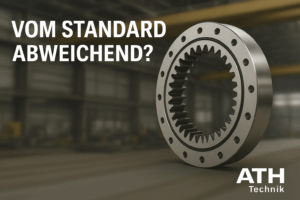
Worm gears, often overlooked and considered obsolete technology, are currently experiencing a renaissance. Worm gears and Slew Drives, which consist of a screw (worm) and a gear (worm gear), offer unique advantages in various industries, ranging from the automotive sector and mechanical engineering to robotics.
What are worm gears?
Worm gears are characterized by their special design. The worm, similar to a screw, engages with the worm wheel, resulting in a rotational movement. The design of slewing drives is similar to a Slewing ring and a worm gear. Their most important feature is the ability to achieve high gear ratios with a compact design. Another advantage is that in many applications they are considered self-locking: the rotation of the worm wheel cannot drive the worm back, which makes them particularly safe and stable.
Where are worm gears used?
Traditionally, worm gears are used in machines that require precise and powerful movements. These include lifting platforms, conveyor belts, and elevators. Due to their compact design and ability to efficiently transmit rotary motion, they can also be found in robots, automated systems, excavators, and many other applications.
In the automotive industry, especially in transmission manufacturing, they are gaining increasing importance. Modern electric vehicles use worm gears to make the drive efficient and increase the longevity of components. They are also increasingly used in medical technology, where precision and reliability are required.
Advantages of worm gears
A key advantage of worm gears is their power transmission efficiency. Despite their simple design, they can support high loads and provide high torque at low speeds. In addition, they run particularly quietly, which makes them attractive in noise-sensitive environments.
Another significant advantage is their self-locking capability. In many fields of application, especially where safety aspects play a role, it is important that the gear mechanism remains in position without the need for additional brakes. Worm gears fulfill this requirement because the movement of the worm wheel cannot be transmitted back to the worm.
Challenges and Outlook
Despite their advantages, worm gears also have disadvantages, especially with regard to their efficiency. Compared to other types of gears, energy losses can occur due to the friction between the worm and the worm wheel, which reduces efficiency. However, engineers are working intensively to minimize these losses. New lubricants and innovative materials are intended to help increase efficiency while simultaneously enhancing durability.
The future of worm gears looks promising. With the rise of electric vehicles, robotics, and automated systems, worm gears could play a key role in the advancement of these technologies over the next few years.